Introducing
Build Math Thinkers Foundations
In this live workshop, K–12 math educators will learn to recognize task avoidance as a symptom of learned helplessness and use high-leverage moves to create classrooms where every student owns their
mathematical thinking.


We all know this student.
The student who raises their hand immediately after instructions are given.
The student who perseveres through the assignment as long as you give them all your attention.
The student who needs you to confirm that they are correct after every step before they keep going.
And, the student who actually knows more mathematics than they are willing to show you.
So, how do we proceed? We do what good teachers have always done.
We scaffold.
We model.
We pull small groups.
We activate prior knowledge.
We give sentence starters.
We find another representation.
We break the problem into smaller pieces.
Sometimes it works. The student finishes the problem, they complete the assignment, and then the cycle begins again with the next concept.
Until we realize we’ve been repeating the same cycle, with the same students, and the same level of support for most of the school year.
So that leaves us with the question:
“When does helping students get through a problem become different
from helping them become independent mathematical thinkers?”
Because eventually, we have to step away.
Students need to know what to do when they are working independently, and equally important, they need to know what to do when they get stuck.
And too often, the first time we really ask students to do both without us is during an assessment.
By then, it’s too late to teach them how.
That is the problem I want us to work through together.

Now imagine something different.
Imagine a student getting stuck and, instead of immediately giving up or looking for the teacher, they trying drawing a representation.
Imagine hearing, “I’m not sure, but I think…” more often than “I don’t know.”
Imagine students asking for help only after they have tried everything they can think of.
Imagine a classroom where Tier 1 instruction remains on grade-level mathematics, and additional supports are provided in response to student need, for only as long as they are needed.
Imagine teachers, special educators, ELL teachers, coaches, and administrators having a shared way to respond to a core question:
“Is this approach increasing the student’s capacity to think or increasing the student’s dependence on support?”
That is the shift.

Now is the time…
… to interrupt the “learned helplessness” cycle once and for all.
Students do not become independent mathematical thinkers simply because we ask nicely.
That means we can’t wait until students prove they have all the skills or until the gaps are filled.

This workshop is for you if…
✅ Students give up or say "I don't know" before they've tried.
✅ Students only persevere through the lesson if an adult confirms every step.
✅ You want to scaffold without creating dependence.
✅ You believe in productive struggle but still wonder: Do I step in or wait?
✅ Your school is implementing HQIM and wants teachers making stronger in-the-moment decisions.
For K–12 math teachers, special educators, EL teachers,
instructional coaches, and leaders who support math classrooms.
In Just 150 minutes, You’ll Be Able To:
💡Recognize dependent thinking habits and notice when students need support versus when they have learned to wait for it.
💡Preserve student thinking by making more intentional decisions about scaffolds without unnecessarily reducing cognitive demand.
💡Build mathematical agency by responding to student uncertainty in ways that help them seek help strategically.
💡Apply the lens to what you already use within your existing curriculum, HQIM, collaborative structures, co-teaching supports, discourse routines, and other existing practices through the question: Who is doing the cognitive work?
Plus, You’ll Walk Away With:
A session workbook with student prompts, teacher reflection prompts, key framework graphics, and space to capture instructional decisions and next steps.
Save Your Spot Now.
Seats fill fast!
Date: Saturday, November 14, 2026
Time: 9:45 am- 12:15 pm (EST)
Location: Online (Link sent after registration)
Cost: $52 per participant
Replay available.
In this live workshop, K–12 math educators will learn to recognize task avoidance as a symptom of learned helplessness and use high-leverage moves to create classrooms where every student owns their mathematical thinking.
For Purchase Orders: Email Nakasha@sincerelyamathstudent.com to receive an invoice with W-9 and payment instructions.

The goal isn’t less support.
It’s better support.
Stop scaffolding? Never
Unfinished learning is real.
This workshop ask math educators to consider one question:
Is the support that we provide helping our most underserved students think or are we simply helping complete assignments?
Sometimes those are the same thing. Sometimes they aren’t.
We need to know the difference. Because if every time a student gets stuck, we figure out how to get them unstuck, we take away the opportunity for them to learn what to do with confusion for themselves.
Students need to know that confusion is a natural part of learning mathematics.
But when their confusion automatically triggers an adult stepping in to add another hint or another scaffold, students can begin to interpret being confused as evidence that they can’t do math without help.
Over time, that becomes bigger than one problem or one assignment. It can shape what students believe about themselves as mathematics learners.
Our job isn’t to eliminate confusion for students.
It’s to help them learn how to navigate their confusion and persevere to sense-making.
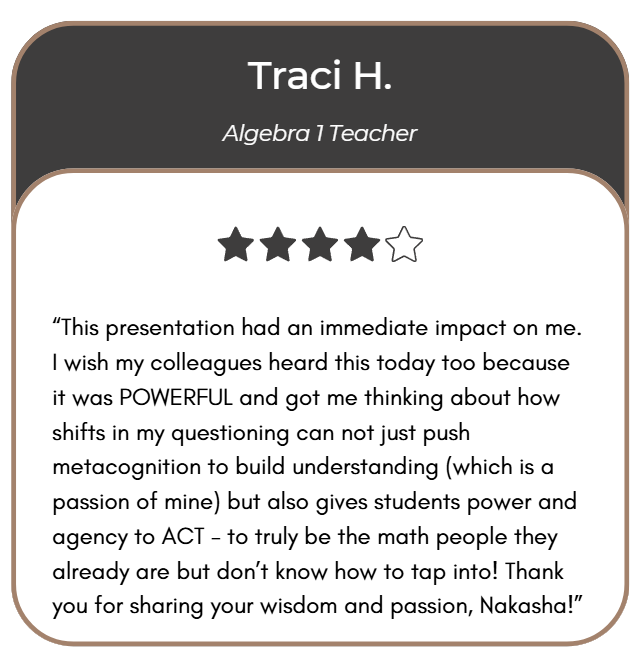
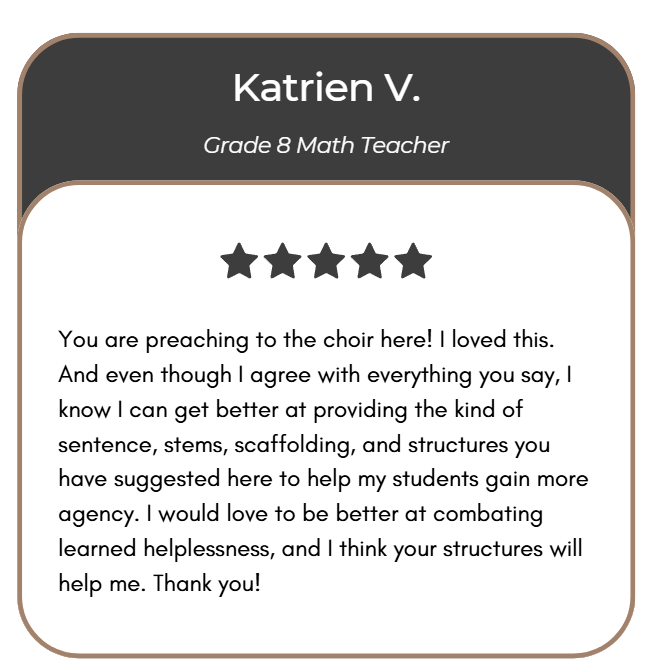
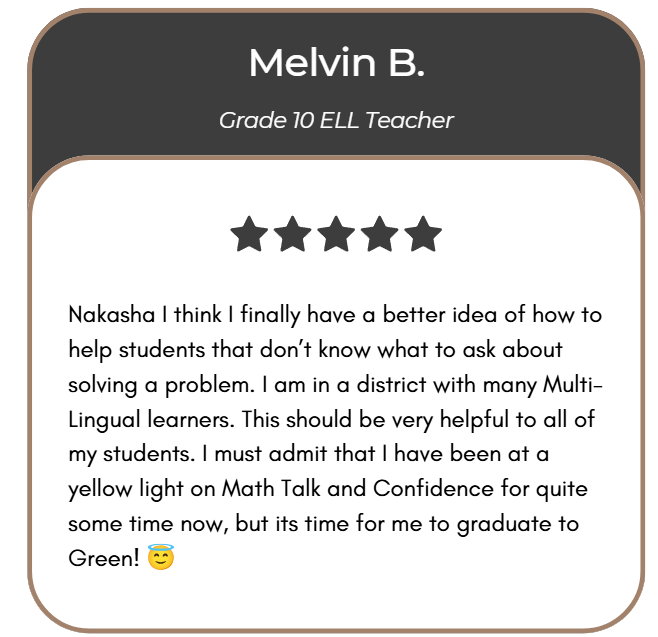
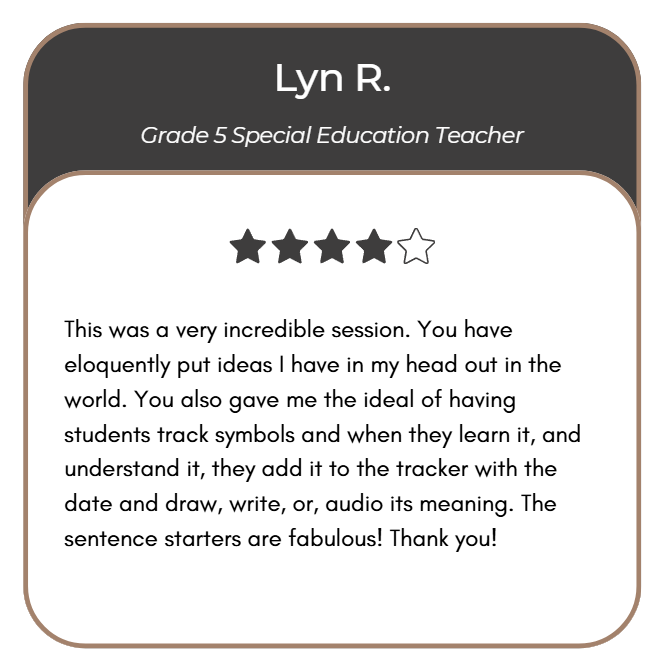
Don’t just take my word for it:
Meet Your Host: Nakasha Kirkland
With over 20 years in education and deep expertise in math instruction and leadership, Nakasha helps school leaders bridge the gap between instructional planning and real growth. She’s trained hundreds of administrators and math teachers across the country and she specializes in turning theory into tools math educators actually use.

FAQ:
-
Not at all.
This workshop is designed to sharpen the teacher decisions that happen inside the curriculum. This workshop will help teachers know when to intervene, what kind of support to provide, and how to respond when students get stuck.
-
The $52 registration fee is per individual participant.
Each person attending the session must register separately. This ensures that every attendee receives their own certificate of completion and access to all workshop materials.
Group registration discounts are available.
-
Absolutely.
If you need to pay by purchase order, contact me and I'll send you an invoice with W-9 and all necessary documentation for your bookkeeper and/or finance department.
Email: Nakasha@sincerelyamathstudent.com -
This is a live workshop with dialogue and time for Q&A.
Replay is available.
-
No refunds will be granted, but funds could possibly be transferred to future offers.
-
Nakasha Kirkland - Nakasha@sincerelyamathstudent.com